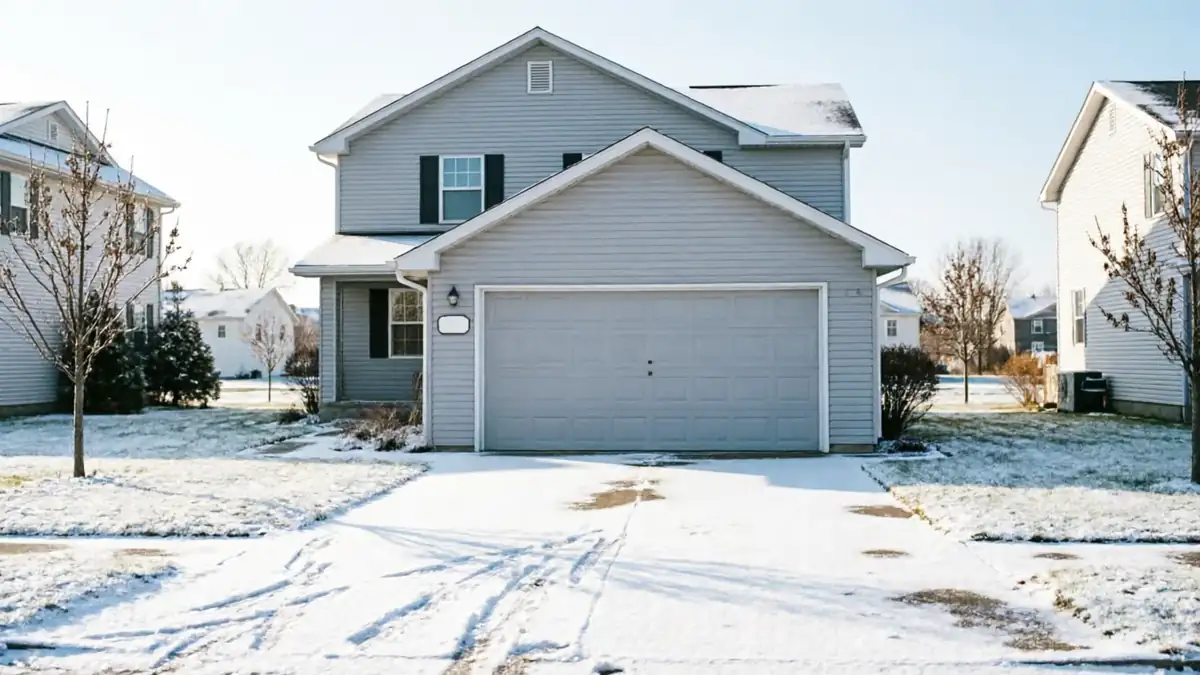
How Local Conditions Play In
Deerfield sits in a cold-moderate climate band, and that matters more for garage door springs than most homeowners realize. Steel contracts as temperature drops, and a torsion spring that's been cycling fine all fall will suddenly have less give in January. The metal gets brittle right at the point where years of flexing have already thinned it out.
Most of the housing stock in this part of the service area went up between the 1960s and 1970s, with the broader range running 1938 to 2009 and a median build year of 1977. A door and spring system installed or replaced on a 1970s-built house has had decades of winters to work on it. If the spring hasn't been swapped since the house was built or last updated, cold is the thing that finally finds the weak point.
This isn't a Deerfield-specific metal problem - it's physics. But the age of the housing here is why we see it play out the way we do: older torsion setups, original hardware in some cases, and springs that were never rated for the cycle count they've actually logged. The cold doesn't cause the wear. It just picks the day.
When to Get Help
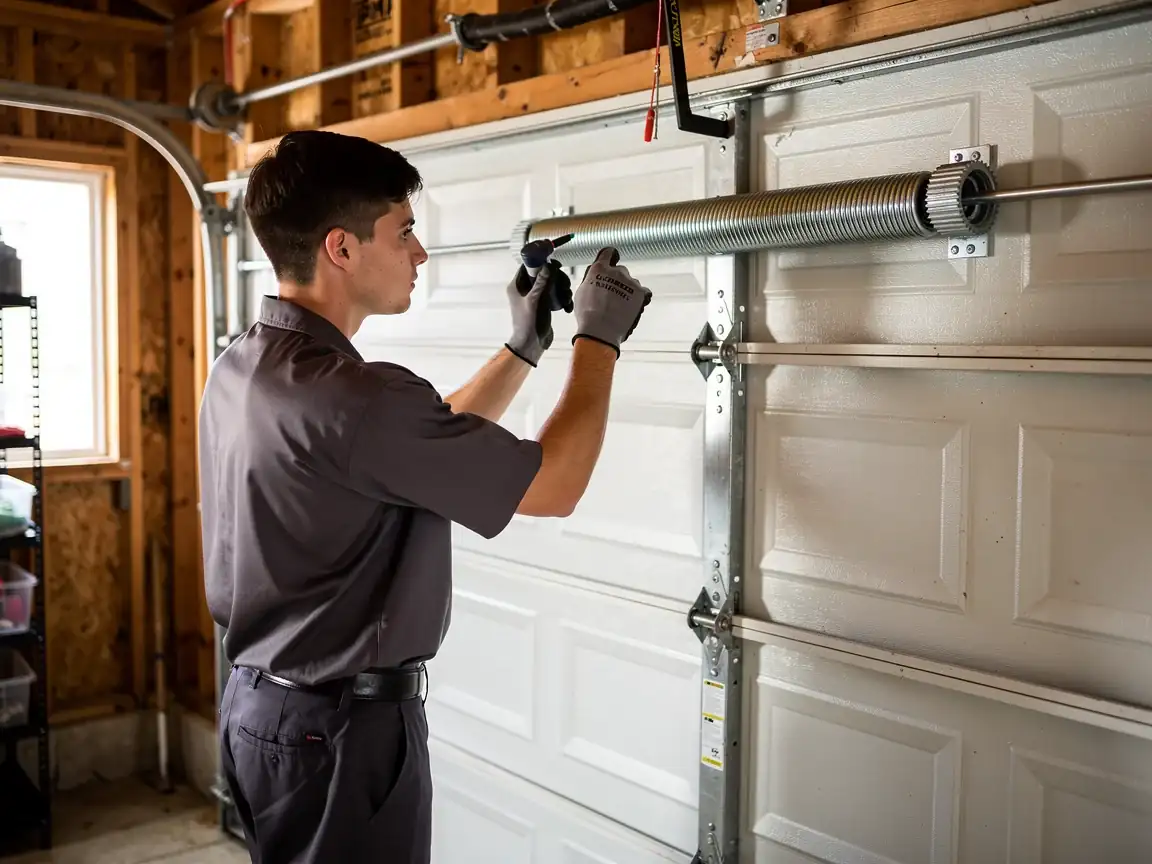
If you hear a bang from the garage on a cold morning and the door won't open, or opens a few inches and stalls, that's almost always a broken torsion spring, not the opener. Don't try to force it by hand or run the opener repeatedly - you can bend the track or burn out the motor trying to lift a door that's lost its spring tension.
Call as soon as you notice the door is heavier than normal, even if it still technically works. A spring under reduced tension is a warning, not a convenience. Houses in this area with original or decades-old torsion hardware are the ones where a slow-developing issue in November turns into a full failure once the cold sets in hard.
If you've got a two-car garage with a single wide door, treat any spring symptom as urgent - those doors run heavier springs, and a failure on a double door is harder and more dangerous to deal with without the right bars and clamps. One honest limitation: if the torsion tube or drum is also rusted or cracked, a spring swap alone won't fix it, and that's a different, bigger job.
The Situation
The service area runs through towns like Bannockburn and Riverwoods, both about 2 miles out, up through Highwood at 3 miles and Lincolnshire at 4
With houses sharing that same mid-century build pattern. Median household income across the service area sits at $125,104, and a lot of these households own rather than rent - 88,612 owner-occupied houses out of 163,436 total households.
- 88,612 owner-occupied
That combination matters for how people deal with a broken spring
Owner-occupied houses tend to get maintenance deferred for years rather than addressed as problems show up, especially on a part like a torsion spring that's invisible until it snaps. Nobody budgets for a spring. It's not until the door won't lift in cold weather that the cost of ignoring it becomes obvious.
Across the 53 named areas we work in, the pattern holds
Homes built mostly in the 1960s and 70s, many still running original or first-replacement spring hardware, and a climate that turns a marginal spring into a dead one somewhere in December or January.
The Common Mistake
The mistake we see most is waiting for the door to fail completely before calling, instead of calling when it starts feeling heavy or making a different sound. A spring losing tension doesn't go from fine to broken overnight - it degrades, and cold weather is usually the final push, not the cause.
The second mistake is assuming a sagging or slow door is an opener problem. On a lot of these older Deerfield-area houses, the opener is newer than the spring - people replace the opener as the visible, electronic part and leave the spring, which just sits there quietly losing strength for another ten years. If your door feels heavier than it used to, the spring is the first thing to check, not the motor.